
Blog

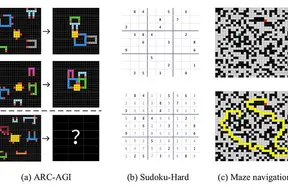
  1. An unexpected success in zero-shot, few-shot and streaming RL

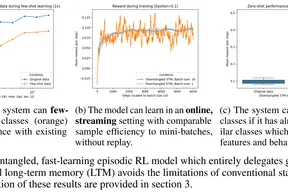
    In the last blog we looked at the phenomenon of “jagged intelligence” — the paradox that AIs are simultaneously superhuman and stupid in adjacent skills. We identified a lack of continual, fast learning and embodiment as possible causes of this weirdness, and noted that embodiment is also a “learning problem”, because current ML models can’t learn from a single thread of…

  2. Not like us: Why AI feels alien, and how to fix it

    Introduction Will highly intelligent machines inevitably think like us? Our experiences with AI that is simultaneously incredibly powerful and incredibly flawed are evidence that not all forms of intelligence are the same. Until recently, all human-level intelligence was human. Now, AI seems to threaten our monopoly. But truly human-level and human-like artificial general intelligence (AGI) is still quite…

  3. HRM-Agent: Using the Hierarchical Reasoning Model in Reinforcement Learning

    Authors: Hoang Long Dang and David Rawlinson UPDATE: Full HRM-Agent paper now available. When the Hierarchical Reasoning Model was released, we were very excited about its combination of small size and impressive reasoning abilities. These qualities seem to be enhanced by recurrent processing, but with a surprisingly simple gradient update based on the converged recurrent forward state — turning a…

  4. Why I’m excited about the Hierarchical Reasoning Model

    Since the arrival of Chat GPT, I’ve felt that progress in AI has been largely incremental. Of course, even Chat GPT was/is mostly just a scaled up Transformer model, which was introduced by Vaswani et al in 2017. The belief that AI is advancing relatively slowly is a radical and unpopular opinion these days, and it’s been…

  5. Grant – Continual Few-Shot Learning

    We are very happy to announce that we’ve been awarded an Artificial Intelligence for Decision Making Initiative grant from Defence Science Institute on Effective updating of deep learning models with limited new data. More specifically, the grant is for the Continual Few-Shot Learning project that we blogged about recently.

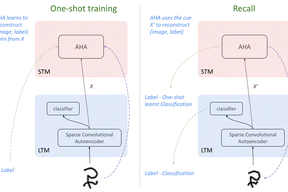
  6. Continual Few-Shot Learning with Hippocampal Replay

    In continual learning, the neural network learns from a stream of data, acquiring new knowledge incrementally. It’s not possible to assume an i.i.d. stationary dataset available in one batch. Catastrophic forgetting of previous knowledge is a well known challenge. A wide variety of approaches fall broadly into 3 categories [6]: Regularization-based methods, Parameter isolation methods…

  7. Video Prediction using Recurrent Sparse Memory

    We recently presented 2 papers at the International Joint Conference on Neural Networks, IJCNN. The first one is about one-shot learning for the long term (with an artificial hippocampal algorithm), blog here. In this blog article, we are excited to share the other paper – Learning distant cause and effect using only local and immediate credit assignment…

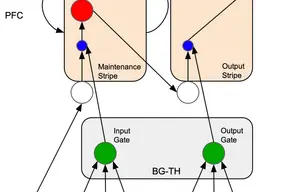
  8. Towards Biologically Inspired Executive Control

    Executive Control is core to what most people recognise as true intelligence. For example, the ability to attend to relevant cues and maintain task dependent information whilst ignoring distracting details and taking appropriate actions. Working Memory (WM) is a core component of Executive Control. “Working memory is a short-term repository for task-relevant information that is…

  9. Research Roadmap: 2020-2021

    We’ve just undertaken a review and refresh of our research roadmap! The topics and approach we will take in the coming year are all laid out in a new page: Research Roadmap Our primary topics for the coming year include: Continual Few-Shot Learning (CFSL) via our Episodic memory system Using reinforcement learning to control a…

  10. Research Roadmap (Aug 2020)

    Research Roadmap The diagram above shows our research roadmap for the coming year (July 2020-June 2021). You can compare to last year’s diagram (below) to see our progress. Red filling indicates completion; yellow indicates areas we expect to make progress this year. The map has two principal stages – improved representations, and generating behaviour using…

  11. 5th WBAI Hackathon

    The Whole Brain Architecture Initiative (WBAI) aims to foster research into architectural approaches to general intelligence. They have held a series of events – the Hackathons – that encourage and support the development of new models which provide working solutions to questions about the possible architecture of general intelligence in the brain. You can read…

  12. AHA! an ‘Artificial Hippocampal Algorithm’ for Episodic Machine Learning

    We’re very happy to report that we recently published a preprint on AHA, an ‘Artificial Hippocampal Algorithm’ for Episodic Machine Learning. It’s the culmination of a multi-year research project and is a starting point for the next wave of developments. This article describes the motivation for developing AHA and a brief description of the research.…

  13. Hippocampus and the Episodic confusion (for machine learning)

    The standard definitions of Episodic and Semantic Memory hide some important subtleties that impact the development of Machine Learning algorithms for AI (particularly those building Episodic Learning capability). This article explores this issue and provides a context for upcoming articles work to take us a step closer to ‘animal-like’ machine learning

  14. Biologically-plausible learning rules for artificial neural networks

    Artificial neural networks (ANNs) – are conceptually simple; the combination of inputs and weights in a classical ANN can be represented as a single matrix product operation followed by an elementwise nonlinearity. However, as the number of learned parameters increases, it becomes very difficult to train these networks effectively. Most of the tricks that enable…

  15. Cerebral networks for conscious access and decision making

    Originally published in March 2019 in an electronic journal in Japanese Introduction The purpose of this essay is to survey the relationship between decision making and large-scale cerebral networks with regard to conscious access, a purported neural correlate of consciousness, and to provide clues for computational modelling and general understanding of the issue. The author…

  16. AI is already harming us – but not the way you think

    As AI/ML researchers, we have obviously pondered the risks of AI. We even wrote about it. But what might surprise you is the risks that keep AI/ML folk awake at night aren’t the ones you hear about in the media. We’re not worried about runaway “paperclip maximizers” or “skynet”-style machine coups. Andrew Ng says: “worrying…

  17. Optimization using Adam on Sparse Tensors

    Adaptive optimization methods, such as Adam and Adagrad, maintain some statistics over time about the variables and gradients (e.g. moments) which affect the learning rate. These statistics won’t be very accurate when working with sparse tensors, where most of its elements are zero or near zero. We investigated the effects of using Adam with varying…

  18. Predictive Capsules Networks – Research update

    We recently talked about Capsules networks and equivariances. NB: If you’re not familiar with Capsules networks, read this first. Our primary objective with Capsules networks is to exploit their enhanced generalization abilities. However, what we’ve found instead raises new questions about how generalization can be measured and whether Capsules networks are actually good at it. PredCaps…

  19. Experiment Infrastructure at Project AGI

    It’s such a joy to be able to test an idea, go straight to the idea without wrestling with the tools. We recently developed an experimental setup which, so far, looks like it will do just that. I’m excited about it and hope it can help you too, so here it is. We’ll go through the why we created another framework, and how each module in the experiment setup works.

  20. Understanding Equivariance

    We are exploring the nature of equivariance, a concept that is now closely associated with the capsules network architecture (see key papers Sabour et al, and Hinton et al). Machine learning representations that capture equivariance must learn the way that patterns in the input vary together, in addition to statistical clusters in the input (that a typical…

  21. Exciting New Directions in ML/AI

    Over the last few years, there have been several breakthroughs and exciting new research directions in Reinforcement Learning, Hippocampus Inspired Architectures, Attention and Few-Shot Learning. There has been a move towards multi-component, heterogeneous, stateful architectures, many guided by ideas from cognitive sciences. Google DeepMind and Google Brain are leading the way making progress on several…

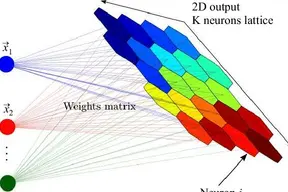
  22. Convolutional Competitive Learning vs. Sparse Autoencoders (2/2)

    This is the second part of our comparison between convolutional competitive learning and convolutional or fully-connected sparse autoencoders. To understand our motivation for this comparison, have a look at the first article. We decided to compare two specific algorithms that tick most of the features we require: K-Sparse autoencoders, and Growing-Neural-Gas-with-Utility (GNG-U) (Fritzke1997). The latter…

  23. Convolutional Competitive Learning vs. Sparse Autoencoders (1/2)

    Competitive learning is a branch of unsupervised learning that was popular a long, long time ago in the 1990s. Older readers may remember – the days before widespread use of GSM mobile phones and before Google won the search engine wars! Although competitive learning is now rarely used, it is worth understanding the broader range of…
  24. Eagerly awaiting TensorFlow Eager Execution?

    Eager Execution is an imperative, object oriented and more Pythonic way of using TensorFlow. It is a flexible machine learning platform for research and experimentation where operations are immediately evaluated and return concrete values, instead of constructing a computational graph that is executed later.

  25. Sparse Unsupervised Capsules Generalize Better

    We’ve just uploaded a spin-off research paper to arXiv titled “Sparse Unsupervised Capsules Generalize Better”. So what’s it all about? Capsules Networks You may have heard of Capsules Networks already – if not, have a read of one of these blog articles (here, here, here, or here (EM routing)), watch this video, or consult one of the…
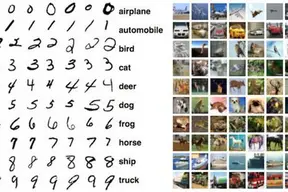
  26. Datasets for Computer Vision

    The dataset is an integral part of an ML engineer’s toolkit. We recently compiled useful information about a range of these well known datasets. It’s all in one place, and hopefully useful to others as well.

  27. The case for Episodic Memory in Machine Learning

    ML Today Today’s Machine Learning has demonstrated unprecedented performance in what seems like every application thrown at it. Almost all the success has been based on advanced memory systems that can learn to recognise an input based on a large number of training examples. This is the equivalent to memory for facts. The biological terminology…

  28. 2018 a Milestone for Project AGI

    2018 is a fresh new year and an exciting milestone for Project AGI. Dave and I have been discussing, dreaming, playing around with and striving towards general purpose AI for over 6 years. It started with musings on the algorithmic underpinnings of consciousness and the nature of intelligence. We quickly moved into the more practical…

  29. Choosing a Machine Learning Framework in 2018

    There are plenty of established machine learning frameworks out there, and new frameworks are popping up frequently to address specific niches. We were interested in examining if one of these frameworks fits in our workflow. I surveyed the most popular frameworks, and aim to provide a helpful comparative analysis.

  30. New Ideas in Reinforcement Learning

    Today’s blog post is about Reinforcement Learning (RL), a concept that is very relevant to Artificial General Intelligence. The goal of RL is to create an agent that can learn to behave optimally in an environment by observing the consequences – rewards – of its own actions. By incorporating deep neural networks into RL agents,…

  31. Reading list – October 2017

    This month’s reading list has two parts: a non-Reinforcement Learning list, and a Reinforcement Learning list. Since our next blog post will be on Reinforcement Learning, readers might like to refer to our RL reading list separately. Non-Reinforcement Learning reading list A Framework for searching for General Artificial Intelligence Authors: Marek Rosa, Jan Feyereisl, The…

  32. Literature Review: ‘A Distributional Perspective on Reinforcement Learning’

    This article assesses the research paper, ‘A Distributional Perspective on Reinforcement Learning’ by the authors, Marc G. Bellemare, Will Dabney and Remi Munos, published in the proceedings of the 34th International Conference on Machine Learning (ICML) in 2017. Bellemare et al.’s paper will be assessed on several criteria. Firstly, content is assessed through providing some…

  33. Introducing Abdel

    Hello everyone! I am Abdelrahman Ahmed (or Abdel for short) and I joined the Project AGI team as a Research Assistant a few months ago. I thought it would be a good time to tell you more about myself and what I am working on at Project AGI. Who am I? Originally from Egypt, I…

  34. Attention in Artificial Intelligence systems

    One of the features of our brain is its modularity. It is characterised by distinct but interacting subsystems that underlie key functions such as memory, language, perceptions, etc. Understanding the complex interplay between these modules requires decomposing them into a set of components. Indeed, this modular approach to modeling the brain is one of the…

  35. Continuous Learning

    The standard machine learning approach is to learn to accomplish a specific task with an associated dataset. A model is trained using the dataset and is only able to perform that one task. This is in stark contrast to animals which continue to learn throughout life and accumulate and re-purpose knowledge and skills. The…

  36. Reading list – August 2017

    1. Neuroscience-inspired Artificial Intelligence Authors: Demis Hassabis, Dharshan Kumaran, Christopher Summerfield, and Matthew Botvinick Type: Review article in Neuron Publication date: 19 July 2017 This paper outlined the contribution of neuroscience to the most recent advances in AI and argued that the study of neural computation in humans and other animals could provide useful (albeit…

  37. AGI Conference 2017

    We attended the 2017 10th Conference on Artificial General Intelligence, which was located in our hometown of Melbourne, Australia! Excitingly, the IJCAI 2017 conference is also in Melbourne this week and ICML 2017 was in Sydney this year. In particular, the “Architectures for Generality and Autonomy” workshop may be of interest to readers. You can find…

  38. AGI Experimental Framework

    We’re very excited to launch AGI Experimental Framework, AGIEF, our open source framework. We first introduced it a while back, at the end of 2015 here, and it has certainly come a long way. AGIEF was created to make running rigorous AI experiments convenient, reproducible and scalable. The goals are: Repeatability: ability to save/load, stop/start…

  39. Unsupervised Learning with Spike-Timing Dependent Plasticity

    Our brain is a source of great inspiration for the development of Artificial General Intelligence. In fact, one of the common views is that any effort in developing human-level AI is almost destined to fail without an intimate understanding of how the brain works. However, we do not understand our brain that well yet. But…

  40. Pyramidal Neurons and Predictive Coding

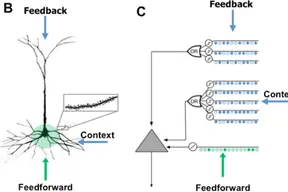
    Today’s post tries to fit the theoretical concept of Predictive Coding with the unusual structure and connectivity of Pyramidal cells in the Neocortex. Pyramidal neurons Pyramidal neurons are interesting because they are one of the most common neuron types in the computational layers of the neocortex. This almost certainly means they are critical to many…

  41. Introducing Yi-Ling

    Hello everyone! I am Yi-Ling and I am the newest member of the AGI project team. It is an incredibly exciting time to be dipping one’s toes in the field of Artificial Intelligence, given the impressive progress and explosion of AI applications in recent years. In my case, I am actually going to dive in…

  42. Open Sourcing MNIST and NIST Preprocessing Code

    In our most recent post we discussed the current set of experiments that we are conducting, using the MNIST dataset. We’ve also been looking at the NIST dataset which is similar, but extends to handwritten letters (as well as digits). These are extremely popular datasets and freely available, so make a great choice for testing…

  43. Region-Layer Experiments

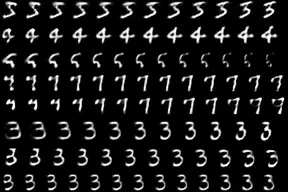
    Typical results from our experiments: Some active cells in layer 3 of a 3 layer network, transformed back into the input pixels they represent. The red pixels are positive weights and the blue pixels are negative weights; absence of colour indicates neutral weighting (ambiguity). The white pixels are the input stimulus that produced the selected…

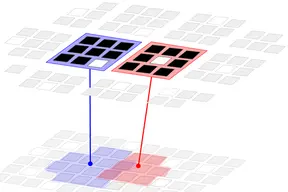
  44. The Region-Layer: A building block for AGI

    Figure 1: The Region-Layer component. The upper surface in the figure is the Region-Layer, which consists of Cells (small rectangles) grouped into Columns. Within each Column, only a few cells are active at any time. The output of the Region-Layer is the activity of the Cells. Columns in the Region-Layer have similar – overlapping –…

  45. Reading list – May 2016

    Digit classification error over time in our experiments. The image isn’t very helpful but it’s a hint as to why we’re excited :) Project AGI A few weeks ago we paused the “How to build a General Intelligence” series (part 1, part 2, part 3, part 4). We paused it because the next article in…

  46. Reading list: Assorted AGI links. March 2016

    A Minecraft API is now available to train your AGIs Our News We are working hard on experiments, and software to run experiments. So this week there is no normal blog post. Instead, here’s an eclectic mix of links we’ve noticed recently. First, AlphaGo continues to make headlines. Of interest to Project AGI is Yann…

  47. What’s after AlphaGo?

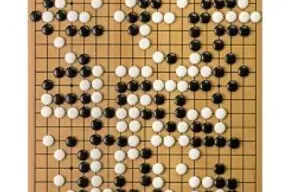
    What’s AlphaGo? AlphaGo is a system that can play Go at least as well as the best humans. Go was widely cited as the hardest (and only remaining) game at which humans could beat machines, so this is a big deal. AlphaGo has just defeated a top-ranked human expert. AlphaGo Nature paper (Silver et al 2016)…

  48. Some interesting finds: Acyclic hierarchical modelling and sequence unfolding

    This week we have a couple of interesting links to share. From our experiments with generative hierarchical models, we claimed that the model produced by feed-forward processing should not have loops. Now we have discovered a paper by Bengio et al titled “Towards biologically plausible deep learning” [1] that supports this claim. The paper looks for…

  49. Intuition over reasoning for AI

    By Gideon Kowadlo I’m reading a fascinating book called The Righteous Mind, by Jonathan Haidt. It’s one of those reads that can fundamentally shift the way that you see the world. In this case, the human world, everyone around you, and yourself. A central idea of the book is that our behaviour is mainly dictated…

  50. How to build a General Intelligence: An interpretation of the biology

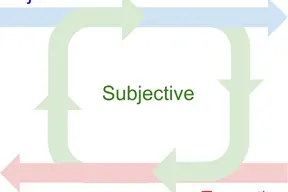
    Figure 1: Our interpretation of the Thalamocortical system as 3 interacting sub-systems (objective, subjective and executive). The structure of the diagram indicates the dominant direction of information flow in each system. The objective system is primarily concerned with feed-forward data flow, for the purpose of building a representation of the actual agent-world system. The executive…

  51. How to build a General Intelligence: Circuits and Pathways

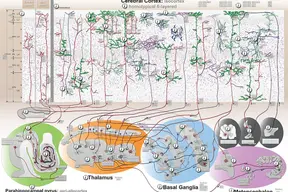
    Figure 1: Our headline image is from the Cognitive Consilience: An atlas of key pathways cross-referenced to supporting literature articles. The complexity and variety of routing within the brain can be appreciated with this beautiful illustration. Note in particular the specialisation of cortical cells and the way this affects their interactions with other cells in…

  52. How to Build a General Intelligence: Reverse Engineering

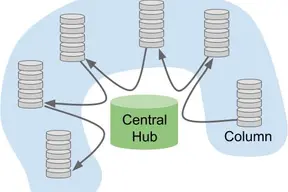
    Figure 1: The physical architecture of general intelligence in the brain, namely the Thalamo-Cortical system. The system comprises a central hub (the Thalamus) surrounded by a surface (the Cortex, shown in blue). The Cortex is made up of a number of functionally-equivalent units called Columns. Each Column is a stack of cell layers. Columns share…

  53. How to build a General Intelligence: What we think we already know

    Authors: D Rawlinson and G Kowadlo This is the first of three articles detailing our latest thinking on general intelligence: A one-size-fits-all algorithm that, like people, is able to learn how to function effectively in almost any environment. This differs from most Artificial Intelligence (AI), which is designed by people for a specific purpose. This…

  54. Digital Reconstruction of Neocortical Microcircuitry (resource)

    We have found a fantastic resource, part of the IBM Blue Brain Project, that clearly and interactively maps out interactions between neocortical neurons. The data comes from their attempts to simulate a piece of cortex down to the level of biologically-realistic neurons. Interactive neocortex browser tool here: https://bbpnmc.epfl.ch/nmc-portal/web/guest/microcircuit The paper containing the original research…

  55. SDR-RL (Sparse, Distributed Representation with Reinforcement Learning)

    Erik Laukien is back with a demo of Sparse, Distributed Representation with Reinforcement Learning. This topic is of intense interest to us, although the problem is quite a simple one. SDRs are a natural fit with Reinforcement Learning because bits jointly represent a state. If you associate each bit-pattern with a reward value, it is…

  56. “Quantum computing” via Sparse distributed coding?

    An interesting article by Gerard Rinkus comparing the qualities of sparse distributed representation and quantum computing. In effect, he argues that because distributed representations can simultaneously represent multiple states, you get the same effect as a quantum superposition. The article was originally titled “sparse distributed coding via quantum computing” but I think that gets the…

  57. AGI Experimental Framework: A platform for AGI R&D

    By Gideon Kowadlo and David Rawlinson Introduction We’ve been building and testing AGI algorithms for the last few years. As the systems become more complex, we have found it ever more difficult to run meaningful experiments. To summarise, the main challenges are: testing a version of the algorithm repeatedly and over some range of parameters…

  58. Reading list – July 2015

    This month’s reading list continues with a subtheme on recurrent neural networks, and in particular Long Short Term Memory (LSTM). First here’s an interesting report on a panel discussion about the future of Deep Learning at the International Conference on Machine Learning (ICML), 2015: http://deeplearning.net/2015/07/13/a-brief-summary-of-the-panel-discussion-at-dl-workshop-icml-2015/ Participants included Yoshua Bengio (University of Montreal), Neil Lawrence (University…

  59. Reading List – May 2015

    John Lisman, “The Challenge of Understanding the Brain: Where We Stand in 2015“, Neuron, 2015 For many in ML and AI, biological knowledge is focussed on cortex. This paper gives an excellent broad overview of current biological understanding of intelligence. Sebastian Billaudelle and Subutai Ahmad, “Porting HTM Models to the Heidelberg Neuromorphic Computing Platform“, arXiv.org, 2015 Progress in…

  60. Consciousness & “Free Will”: The Elephants in the Room

    By David Rawlinson and Gideon Kowadlo The aim of this post is to take a short departure from more technical issues and deal with some of the philosophical questions about Artificial General Intelligence (AGI). The Elephant in the room This metaphor implies willful ignorance of something blindingly obvious. Something that’s difficult to ignore. It requires effort…

  61. A nomenclature for Cortical Columns and related concepts.

    By Gideon Kowadlo and David Rawlinson In our last blog post, we discussed the repeating functional columnar structure of the neocortex, and the inconsistent terminology used to discuss it throughout the literature. As mentioned in that post, the function of the column is an important concept for understanding the function of the neocortex, and as a consequence,…

  62. Mini, macro, micro and hyper columns: confusing terminology

    Cell-type-specific 3D reconstruction of five neighboring barrel columns in rat vibrissal cortex (credit: Marcel Oberlaender et al.) It is well established that there is a functional columnar structure repeated throughout the cortex across species (the concept received significant attention after a study by Mountcastle in 1957 [1]; see [2] and [3] for reviews). This suggests…

  63. Another look at the retina

    by David Rawlinson and Gideon Kowadlo Why the retina is worth a deeper look Recently, we have been looking at the retina – light sensitive cell layers inside the eyeball, that detect wavelength and intensity, and compute some initial encoding of this data that is transmitted to the brain proper via the optic nerve. The…

  64. The Arcade Learning Environment – a test suite for AGI

    This might be our new test suite for the algorithms! http://www.arcadelearningenvironment.org/ “The Arcade Learning Environment (ALE) is a simple object-oriented framework that allows researchers and hobbyists to develop AI agents for Atari 2600 games. It is built on top of the Atari 2600 emulator Stella and separates the details of emulation from agent design.” Why…

  65. Eric Horvitz on the new era of AI

    I found this video interview with Eric Horvitz, the head of Microsoft Research, to be a really interesting window into their work and vision – a large part of which is AI. As Eric states, there is a “growing consensus that the next, if not last, enduring competitive battlefield, among major IT companies will be…

  66. Mitigating the perceived future risks of AI

    Just a few days ago, Jay posted here about the recent public attention to AI and the potential future dangers that it presents. Discussion on the topic continues, but it’s not all talk. There are at least two institutes focussed on practical steps to mitigate the risks. There is an institute called MIRI that exists…

  67. The Real Risks of AI

    By Punarjay Chakravarty In the past year or so, there has been a spate of high-profile pronouncements by respected scientists and engineers, cautioning the world about the potential ill-effects of AI. Stephen Hawking, one of the foremost experts on theoretical and astro physics told the BBC that “The development of full artificial intelligence could spell…

  68. A response to “when is missing data a valid state?”

    I recently published a post on the question of classifying ‘no input’ or missing data. There was a comprehensive reply by Fergal Byrne in a thread on the Nupic Theory mailing list. I am re-posting it here (below) as it provides a valuable perspective of the discussion in the context of human cortical function. Jan 24th 2015 – by Fergal Byrne…

  69. Consciousness and AI

    I really enjoyed reading this article Why can’t the world’s greatest minds solve the mystery of consciousness? published recently in the Guardian. It’s an engaging re-exploration of the contemporary discourse on the classic mind-body dilemma. One view is that the ‘hard problem’ of consciousness is an illusion. There is no separation between mind and body, and that…

  70. Mathematics of HTM by Fergal Byrne

    If you’re looking for a formal and precise description of the current HTM/CLA algorithm, then this blog [1, 2] by Fergal Byrne may be of interest. Our experience is that while pseudocode is a good way of describing an algorithm, equations can often be more succinct and specific. The CLA whitepaper [3] describes the algorithm…

  71. When is missing data a valid state?

    By Gideon Kowadlo, David Rawlinson and Alan Zhang Can you hear silence or see pitch black? Should we classify no input as a valid state or ignore it? To my knowledge, the machine learning and statistics literature mainly regards an absence of input as missing data. There are several ways that it’s handled. It can…

  72. Deep learning, a history in context

    DeepMind, based on a deep learning architecture made a big impact in the tech industry. Deep learning continues to gain traction in the machine learning community and in the mainstream, both in terms of public awareness of its capabilities as well as through commercialisation. This article by Simon Winder provides a very accessible introduction to…

  73. Sparse Distributed Representations (SDRs)

    TL;DR: An SDR is a Sparse Distributed Representation, described below SDRs are biologically plausible data structures SDRs have powerful properties SDRs have received a lot of attention recently There are a few really great new resources on the topic: Presentation by Subutai Ahmad of Numenta Older introductory presentation by Jeff Hawkins Excellent summary of their characteristics in…

  74. Agency and Hierarchical Action Selection

    This post asks some questions about the agency of hierarchical action selection. We assume various pieces of HTM / MPF canon, such as a cortical hierarchy. Agency The concept of agency has various meanings in psychology, neuroscience, artificial intelligence and philosophy. The common element is having control over a system, with varying qualifiers regarding the entities…

  75. Recent HTM projects

    It’s exciting to see growing interest and participation in the AGI community. This is another brief post to share two examples. In this case, they both build on one approach to AGI, and that is HTM. FXAI – Explorations Into Computational Intelligence A blog that is pretty well described by the title. The author, Felix…

  76. A Unifying View of Deep Networks and Hierarchical Temporal Memory

    Browsing the NUPIC Theory mailing list, I came across a post by Fergal Byrne on the differences and similarities between Deep Learning and MPF/HTM. It’s a great background into some of the pros and cons of each. Given the popularity and demonstrated success of Deep Learning methods it’s good to understand how they work and how…

  77. On Predictive Coding and Temporal Pooling

    Introduction Predictive Coding (PC) is a popular theory of cortical function within the neuroscience community. There is considerable biological evidence to support the essential concepts (see e.g. “Canonical microcircuits for predictive coding” by Bastos et al). PC describes a method of encoding messages passed between processing units. Specifically, PC states that messages encode prediction failures; when…

  78. Some experimental results with NUPIC

    A quick post here to give readers an idea of HTM/CLA performance on visual object recognition tasks. Although a little out of date now, Craig’s blog gives a good idea of what NUPIC can and can’t do, and how data issues (e.g. training set, variations in object appearance) affect the results. This is a handy…

  79. Connectome browser – hierarchy viewer?

    Hierarchy Viewer? Ongoing research to map out the patterns of connectivity in the human brain continues to produce stunning visuals. Are we looking at the hierarchy as proposed in the Memory-Prediction framework? In any case, it’s fun to explore, which you can do here: http://www.humanconnectomeproject.org/data/relationship-viewer/

  80. TP 3/3: Proposed Temporal Pooler

    by David Rawlinson and Gideon Kowadlo A Temporal Pooler Proposal We will describe a Temporal Pooler design below. We have tested this design and it gives satisfactory output given the criteria and expectations described below and in the previous articles in this series (post #1, post #2). It is also relatively simple. You could imagine this…

  81. TP 2/3: Jeff’s new Temporal Pooler

    By David Rawlinson and Gideon Kowadlo Jeff’s new Temporal Pooler This is article 2 in a 3 part series about Temporal Pooling (TP) in MPF/CLA-like algorithms. You can read part 1 here. For the rest of this article we will assume you’ve read part 1. This article is about the new TP proposed by Jeff Hawkins. The…

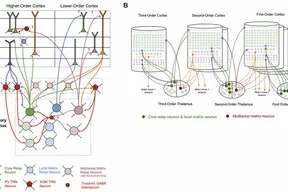
  82. Thalamocortical architecture

    by Gideon Kowadlo and David Rawlinson Introduction One of the keys to understanding the neocortex as a whole, and the emergence of intelligence, is to understand how the cortical hierarchical levels interconnect. This includes: the physical connections, the meaning of the signals being transmitted, and possibly also the way the signal is encoded. Physical connections: Physical…

  83. Constraints on intelligence

    by Gideon Kowadlo and David Rawlinson Introduction This article contains some musings on the factors that limit the increase of intelligence as a species. We speculate that ultimately, our level of intelligence is limited by at least two factors, and possibly a third: our own cultural development, physical constraints, and an intelligence threshold. We’ll now…

  84. A notation for intracortical neural connections

    by Gideon Kowadlo and David Rawlinson In a previous post (section ‘Regions’), we discussed the distinction between cortical layers and levels. The literature often describes connections between cortical layers in one level to cortical layers in another level. We are not aware of a written convention for this purpose and propose one here. The basic form describes…

  85. TP 1/3: Temporal Pooler background

    by David Rawlinson and Gideon Kowadlo Article Series This is the first of 3 articles about temporal pooler design for Numenta’s Cortical Learning Algorithm (CLA) and related methods (e.g. HTM/MPF). It has limited relevance to Deep Belief Networks. This first part will describe some of the considerations, objectives and constraints on temporal pooler design. We…

  86. Architecture of the Memory Prediction Framework / Cortical Learning Algorithm / Hierarchical Temporal Memory

    by David Rawlinson and Gideon Kowadlo Introduction The Memory Prediction Framework (MPF) is a general description of a class of algorithms. Numenta’s Cortical Learning Algorithm (CLA) is a specific instance of the framework. Numenta’s Hierarchical Temporal Memory (HTM) was an earlier instance of the framework. HTM and CLA adopt different internal representations so it is…

  87. Introduction

    by David Rawlinson and Gideon Kowadlo The Blog This blog will be written by several people. Other contributors are welcome – send us an email to introduce yourself! The content will be a series of short articles about a set of common architectures for artificial general intelligence (AGI). Specifically, we will look at the…